
Modern commercial and industrial facilities depend on reliable fuel storage systems to maintain continuous operations, support emergency power, and ensure the safe handling of flammable and combustible liquids. Whether supplying standby generators in hospitals, fueling heavy equipment on construction sites, or supporting industrial process equipment, fuel tanks are far more than simple storage containers. They are engineered systems that must safely contain fuel, withstand environmental conditions, integrate with mechanical and electrical infrastructure, and comply with numerous U.S. building, fire, and environmental regulations.
Designing an effective fuel tank requires balancing structural engineering, material selection, fabrication quality, corrosion protection, safety features, and long-term maintainability. Engineers must consider static and dynamic loading, thermal expansion, secondary containment, fuel compatibility, seismic anchorage, and inspection access while ensuring compliance with standards such as UL 142, UL 2085, NFPA 30, the International Fire Code (IFC), EPA Spill Prevention, Control, and Countermeasure (SPCC) requirements, and applicable provisions of the International Building Code (IBC) and California Building Code (CBC). For mission-critical facilities such as hospitals and data centers, additional design considerations may include HCAI requirements, emergency generator integration, and enhanced reliability expectations.
Advancements in laser cutting, CNC machining, robotic welding, and precision metal fabrication have also transformed how modern fuel tanks are manufactured. Today’s engineered fuel storage systems are designed for longer service life, easier maintenance, improved corrosion resistance, and greater adaptability to custom applications.
This guide explores the engineering principles behind fuel tanks, including common tank types, fabrication methods, structural support systems, material selection, applicable codes, installation practices, and industry applications. It also examines how engineering services such as structural analysis, BIM coordination, custom fabrication, and quality assurance contribute to reliable fuel storage solutions for commercial, industrial, and infrastructure projects.
What Is a Fuel Tank?
A fuel tank is an engineered vessel designed to safely store, contain, and deliver liquid fuels such as diesel, gasoline, biodiesel, or alternative fuels for stationary or mobile applications. While the basic function appears straightforward, modern fuel tanks incorporate numerous structural and safety features that ensure reliable operation throughout decades of service.
Industrial fuel tanks must safely withstand internal hydrostatic pressure, environmental exposure, mechanical loading, thermal movement, transportation forces, and, in many cases, seismic events. They also provide controlled interfaces for filling, dispensing, venting, monitoring, inspection, and maintenance.
Fuel Tanks
Purpose of Industrial Fuel Tanks
Industrial fuel tanks serve multiple purposes beyond simple storage. Depending on the application, they may provide:
- Primary fuel storage
- Emergency fuel reserves
- Day tank supply for generators
- Mobile equipment fueling
- Process fuel storage
- Fleet fueling systems
- Backup power infrastructure
The required capacity varies considerably, ranging from compact generator day tanks to large aboveground storage tanks serving industrial facilities or utility infrastructure.
Fuel Storage Versus Equipment Fuel Tanks
Fuel tanks generally fall into two broad categories.
Fuel storage tanks are stationary systems intended to store larger fuel volumes for distribution to generators, equipment, or dispensing systems. These installations frequently include secondary containment, leak detection, fuel transfer pumps, monitoring equipment, and environmental safeguards.
Equipment fuel tanks are integrated directly into machines such as generators, construction equipment, agricultural machinery, mining equipment, or commercial vehicles. These tanks prioritize compact packaging, weight reduction, vibration resistance, and serviceability.
Although their applications differ, both require careful engineering to ensure structural reliability and safe operation.
Common Commercial and Industrial Applications
Fuel tanks are used throughout numerous industries, including:
- Hospitals
- Data centers
- Manufacturing facilities
- Airports
- Government buildings
- Water treatment plants
- Oil and gas facilities
- Utility substations
- Emergency response centers
- Telecommunications infrastructure
- Mining operations
- Marine facilities
Each application presents unique engineering challenges involving fuel capacity, environmental exposure, accessibility, fire protection, and regulatory compliance.
Types of Fuel Tanks
Selecting the appropriate fuel tank configuration depends on operational requirements, installation conditions, environmental regulations, maintenance considerations, and available space. Understanding the advantages of each design helps engineers specify systems that meet both performance and regulatory objectives.
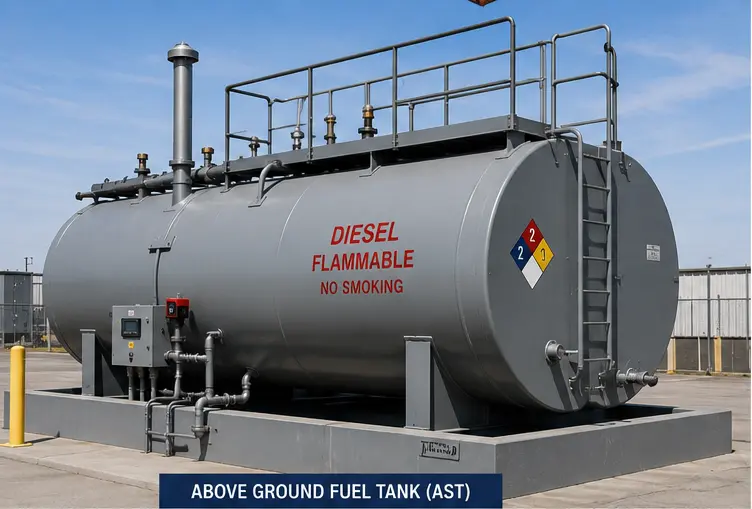
Aboveground Fuel Tanks (AST)
Aboveground Storage Tanks (ASTs) are widely used in commercial and industrial facilities because they simplify inspection, maintenance, leak detection, and replacement compared to underground systems.
ASTs are commonly installed for:
- Generator fuel storage
- Fleet fueling
- Industrial process equipment
- Emergency power systems
- Manufacturing facilities
Most engineered ASTs intended for combustible liquids comply with UL 142 and applicable fire codes.
Fuel Tanks
Underground Fuel Tanks (UST)
Underground Storage Tanks are often selected where site constraints or aesthetic considerations limit aboveground installations.
Although they reduce the visual impact of fuel storage, USTs require more extensive environmental protection, leak detection, corrosion prevention, and monitoring systems due to the potential impact of subsurface fuel releases.
Installation, inspection, and maintenance requirements are generally more complex than for aboveground tanks.
Single-Wall Fuel Tanks
Single-wall tanks consist of one structural shell designed to contain fuel. While suitable for many applications, they often require external secondary containment systems depending on local regulations and environmental risk assessments.
Single-wall tanks remain common in controlled industrial settings where containment infrastructure already exists.
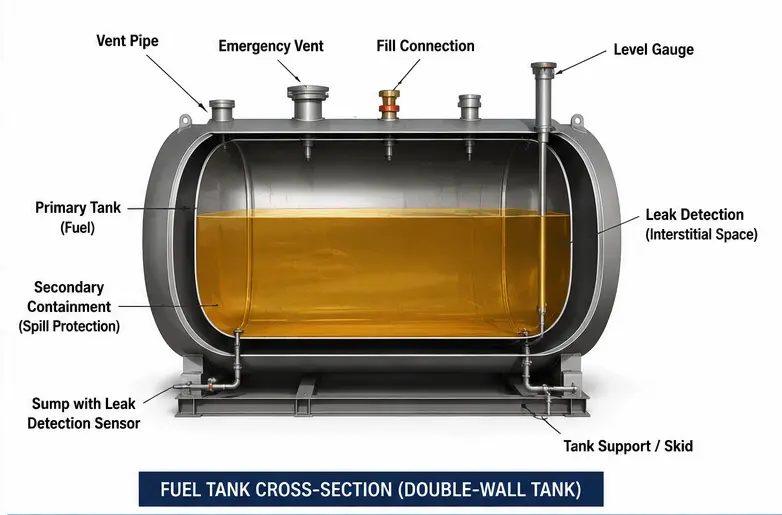
Double-Wall Fuel Tanks
Double-wall tanks incorporate an inner storage vessel surrounded by an outer containment shell. The interstitial space between the walls allows leak monitoring while providing built-in secondary containment.
These systems reduce environmental risks and simplify compliance with many regulatory requirements.
Generator Day Tanks
Generator day tanks provide an intermediate fuel supply located near emergency generators. Rather than storing long-term fuel reserves, they maintain a smaller working volume supplied automatically from larger bulk storage tanks.
Day tanks commonly include:
- Automatic fill controls
- Fuel level sensors
- Leak monitoring
- Overflow protection
- Return fuel connections
They play a critical role in hospitals, data centers, and mission-critical facilities where uninterrupted power is essential.
Belly Fuel Tanks
Belly tanks are mounted beneath generators or equipment skids to minimize installation space while integrating fuel storage directly into the equipment package.
These designs simplify transportation, installation, and maintenance by combining structural support and fuel storage into a single assembly.
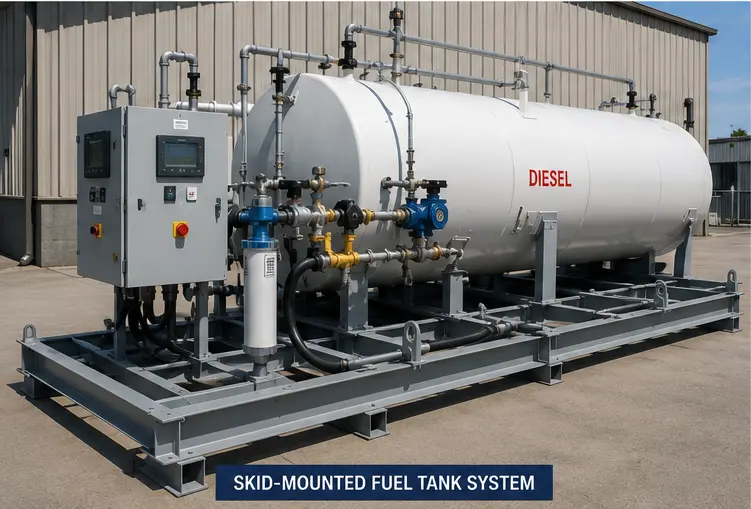
Skid-Mounted Fuel Tanks
Skid-mounted systems integrate the tank, structural frame, piping, pumps, and controls into a factory-assembled package.
This approach reduces field installation time while improving quality control through shop fabrication and testing.
Selecting the Right Tank Configuration
Engineers typically evaluate:
- Required storage capacity
- Installation location
- Available footprint
- Fire code requirements
- Environmental regulations
- Maintenance accessibility
- Seismic considerations
- Future expansion needs
- Operational reliability
Selecting the appropriate configuration early in project planning helps optimize lifecycle performance while minimizing installation challenges.
Fuel Tank Materials and Corrosion Protection
Material selection directly influences the durability, safety, manufacturability, and lifecycle cost of a fuel tank. Engineers must evaluate mechanical properties, corrosion resistance, fabrication methods, operating temperatures, and expected environmental exposure before selecting the most appropriate material.
Carbon Steel
Carbon steel remains the most widely used material for industrial fuel tanks because it provides excellent strength, weldability, and cost-effectiveness.
ASTM A36 structural steel is frequently specified for aboveground storage tanks, structural supports, and welded assemblies where high structural performance is required.
With appropriate coatings and maintenance, carbon steel tanks can provide decades of reliable service.
Stainless Steel
Stainless steel offers significantly improved corrosion resistance compared to carbon steel and is often selected for aggressive environments where moisture, chemicals, or marine exposure accelerate corrosion.
Type 304 stainless steel is commonly used for general industrial applications, while Type 316 provides enhanced resistance in coastal or chemical processing environments.
Although stainless steel increases initial costs, it may reduce maintenance and extend service life.
Aluminum
Aluminum fuel tanks are widely used where weight reduction is an important design objective.
Commercial transportation, mobile equipment, aerospace, and marine industries frequently utilize aluminum because it provides:
- High corrosion resistance
- Reduced structural weight
- Excellent fabrication characteristics
- Good thermal conductivity
Common alloys include 5052 and 6061 depending on structural requirements.
Hot-Dip Galvanized Steel
Hot-dip galvanizing protects steel components through a durable zinc coating that resists corrosion even in harsh outdoor environments.
Galvanized structural supports, mounting frames, and ancillary hardware frequently complement painted or coated fuel tank assemblies.
Protective Coatings
Protective finishes significantly extend service life by shielding metal surfaces from moisture, chemicals, ultraviolet exposure, and atmospheric contaminants.
Common coating systems include:
- Epoxy coatings
- Polyurethane coatings
- Powder coating
- Zinc-rich primers
- Specialized fuel-resistant coatings
Proper surface preparation is essential to achieving long-term coating performance.
Material Selection by Application
No single material is ideal for every project.
Engineers evaluate numerous factors, including:
- Fuel type
- Operating environment
- Temperature exposure
- Corrosion potential
- Structural loading
- Weight limitations
- Maintenance expectations
- Lifecycle cost
Balancing these considerations results in a fuel tank that meets both performance and economic objectives while supporting long-term reliability.
Fuel Tanks
Fuel Tank Structural Design and Engineering
A fuel tank functions as both a storage vessel and a structural component. Its design must safely resist hydrostatic pressure, dead loads, transportation forces, wind loading, seismic effects where applicable, and operational stresses throughout its service life.
Load Calculations
Structural design begins with evaluating all anticipated loading conditions. Engineers consider:
- Fuel weight
- Tank self-weight
- Roof loads
- Wind loads
- Seismic forces
- Transportation loads
- Equipment attachments
These calculations determine plate thicknesses, reinforcement requirements, support spacing, and anchorage design.
Internal Baffles
Internal baffles reduce fuel movement inside partially filled tanks.
By limiting liquid sloshing, baffles improve structural stability during transportation and reduce dynamic loads imposed on the tank shell and support structure.
They also contribute to improved vehicle handling and reduced fatigue in mobile applications.
Thermal Expansion
Fuel tanks experience temperature changes caused by weather, fuel temperature fluctuations, and nearby equipment.
Designers accommodate thermal expansion through flexible piping connections, expansion allowances, and properly engineered supports that prevent excessive stress concentrations.
Structural Reinforcement
Large tanks often require reinforcement around openings, lifting points, support locations, and high-stress regions.
Reinforcement plates, stiffeners, gussets, and structural framing help distribute loads while maintaining overall structural integrity.
Tank Supports
Support systems must evenly distribute loads while maintaining alignment and providing sufficient access for inspection and maintenance.
Support methods may include:
- Structural steel frames
- Saddles
- Skid bases
- Concrete foundations
- Elevated structural platforms
Support selection depends on tank size, installation location, operational requirements, and applicable building codes.
Service Accessibility
Good engineering extends beyond structural performance.
Designers also provide access to:
- Fill connections
- Inspection ports
- Gauges
- Valves
- Monitoring equipment
- Maintenance areas
Adequate service clearance reduces maintenance costs and improves operational safety.
Design Life Considerations
Fuel tanks are frequently expected to remain in service for several decades.
Design decisions regarding materials, corrosion protection, weld quality, structural redundancy, and inspection accessibility all influence long-term durability and total lifecycle cost.
Fuel Tank Support Systems and Mounting
A well-engineered fuel tank is only as reliable as the structure supporting it. Even a tank manufactured to the highest standards can experience premature wear, leakage, or structural damage if its mounting system is improperly designed or installed. Fuel tank support systems must safely transfer static and dynamic loads into the supporting structure while accommodating thermal movement, vibration, maintenance access, and, in many facilities, seismic forces.
The design approach varies depending on whether the tank serves an emergency generator, industrial process, mobile equipment, or bulk fuel storage application. Engineers evaluate tank dimensions, fuel capacity, operating weight, center of gravity, environmental exposure, and anticipated loading conditions before selecting the most appropriate support configuration.
Structural Support Frames
Structural steel support frames provide a rigid foundation for elevated or skid-mounted fuel tanks. Fabricated from ASTM A36 or high-strength structural steel tubing and plate, these frames distribute loads uniformly while maintaining dimensional stability throughout the tank’s service life.
Custom support frames often incorporate:
- Welded structural tubing
- Reinforced cross members
- Base plates
- Lifting provisions
- Equipment mounting rails
- Integrated piping supports
- Access platforms where maintenance requires elevated access
For generator installations, support frames frequently integrate with equipment skids, simplifying transportation, installation, and long-term maintenance.
Fuel Tank Saddles
Horizontal cylindrical tanks commonly use saddle supports that distribute weight over a larger section of the shell rather than concentrating loads at isolated points.
Proper saddle design minimizes:
- Shell distortion
- Localized stresses
- Fatigue around welded joints
- Long-term deformation
Engineers also account for shell expansion caused by temperature changes. Improper saddle spacing or rigid restraint can create excessive stress concentrations that shorten service life.
Equipment Skids
Many commercial and industrial applications utilize skid-mounted fuel systems combining multiple components into a single engineered assembly.
A typical fuel skid may include:
- Fuel tank
- Structural base frame
- Transfer pumps
- Filtration systems
- Control panels
- Leak detection equipment
- Secondary containment
- Instrumentation
- Piping assemblies
Factory-assembled skids reduce field labor, improve quality control, and simplify commissioning.
Skid-mounted systems are particularly common in hospitals, data centers, wastewater treatment plants, and emergency operations centers where installation schedules are tightly controlled.
Anchor Bolts and Foundation Design
Anchorage is often overlooked until late in a project, yet it plays a significant role in overall system reliability.
Anchor bolt design considers:
- Dead load
- Operating fuel weight
- Wind forces
- Seismic forces
- Equipment vibration
- Overturning moments
- Concrete strength
- Edge distances
- Anchor spacing
Both cast-in-place and post-installed anchors may be appropriate depending on the project phase and structural conditions.
Proper anchor design helps prevent movement during equipment operation while maintaining structural integrity during extreme loading events.
Seismic Anchorage
Facilities located in moderate- to high-seismic regions require additional engineering to protect fuel systems during earthquakes.
Although fuel tanks are primarily governed by fire and environmental regulations, seismic anchorage must also satisfy structural design requirements under the International Building Code (IBC), California Building Code (CBC), and ASCE 7 where applicable.
Critical facilities—including hospitals, emergency response centers, and data centers—often require engineered seismic restraint systems designed to:
- Prevent sliding
- Resist overturning
- Protect connected piping
- Maintain emergency power operation
- Reduce post-earthquake repair requirements
The Sigma Source supports these projects through structural engineering, seismic calculations, and custom anchorage solutions that integrate fuel systems into the overall building structure.
Flexible Fuel Connections
Rigid piping connections can unintentionally transfer loads between stationary structures and fuel tanks. Differential settlement, thermal expansion, vibration, or seismic movement may overstress piping, nozzles, or welded joints.
Flexible connectors help accommodate:
- Thermal growth
- Equipment vibration
- Minor building movement
- Installation tolerances
- Seismic displacement
Proper flexibility reduces maintenance issues while protecting pumps, valves, and piping systems from unnecessary mechanical stress.
Vibration Isolation
Fuel tanks supporting diesel generators or heavy rotating equipment often experience continuous vibration.
Without adequate isolation, vibration may contribute to:
- Weld fatigue
- Fastener loosening
- Instrument failures
- Noise transmission
- Premature piping wear
Depending on equipment characteristics, engineers may incorporate:
- Rubber vibration isolators
- Spring isolators
- Wire rope isolators
- Flexible mounting assemblies
Selecting the appropriate isolation method requires evaluating operating frequency, equipment weight, expected vibration amplitudes, and environmental conditions.
A comprehensive mounting strategy combines structural support, flexible piping, proper anchorage, and vibration control to maximize system reliability while minimizing lifecycle maintenance costs.
Fuel Tank Fabrication Processes
Industrial fuel tanks are precision-engineered pressure-containing structures that require disciplined fabrication practices to ensure safety, durability, and compliance with applicable standards. From raw material preparation through final inspection, every manufacturing step influences structural integrity, leak resistance, corrosion performance, and long-term reliability. For custom tanks serving emergency generators, industrial plants, or OEM equipment, fabrication quality is often as important as the initial design.
Modern fabrication facilities combine digital manufacturing technologies with skilled craftsmanship to produce tanks that meet demanding operational requirements while maintaining consistent dimensional accuracy.
Laser Cutting
Laser cutting provides exceptional precision when producing fuel tank components from carbon steel, stainless steel, or aluminum plate. Computer-controlled laser systems create clean edges with minimal heat-affected zones, reducing the need for secondary finishing operations.
Benefits include:
- High dimensional accuracy
- Consistent part repeatability
- Complex profile cutting
- Reduced material waste
- Improved fit-up during assembly
Precision-cut components contribute to stronger welds by ensuring tighter tolerances throughout the fabrication process.
Plasma Cutting
For thicker plate materials commonly used in large industrial fuel tanks, plasma cutting offers an efficient and economical solution. CNC plasma systems rapidly process structural steel while maintaining acceptable edge quality for subsequent welding and forming operations.
Plasma cutting is frequently used for:
- Base plates
- Reinforcement plates
- Structural support members
- Mounting brackets
- Skid assemblies
When paired with CNC programming, plasma cutting supports both prototype development and high-volume production.
CNC Machining
Although most fuel tank structures are fabricated from welded plate and tubing, precision-machined components are often required for threaded ports, mounting surfaces, flanges, inspection covers, and specialty fittings.
CNC machining ensures proper alignment of critical interfaces, helping prevent leaks and simplifying field assembly. Accurate machining also improves compatibility with pumps, gauges, valves, and monitoring equipment.
Plate Forming and Fabrication
Fuel tank geometry often requires rolling, bending, and forming operations before welding. Cylindrical shells, formed end caps, baffles, and structural stiffeners must maintain tight dimensional tolerances to ensure proper assembly and long-term structural performance.
Internal baffles are commonly incorporated to reduce fuel movement during transportation or equipment operation. By controlling fuel slosh, these components decrease dynamic loading on the tank walls and improve overall stability.
Additional structural features may include reinforced lifting lugs, anchor plates, equipment supports, and integrated piping penetrations designed to meet specific application requirements.
Welding Processes
Welding is one of the most critical stages of fuel tank fabrication. Joint quality directly affects leak prevention, structural strength, and fatigue resistance.
Common welding methods include:
- MIG (Gas Metal Arc Welding) for high-production carbon steel fabrication
- TIG (Gas Tungsten Arc Welding) for stainless steel, aluminum, and precision components
- Flux-cored arc welding for heavy structural assemblies where higher deposition rates are beneficial
Fabricators typically follow qualified welding procedures in accordance with AWS D1.1 for structural steel and AWS D1.6 for stainless steel applications. Weld sequencing is carefully planned to minimize distortion while maintaining dimensional accuracy.
Hydrostatic Testing and Inspection
Before shipment, completed fuel tanks undergo testing to verify structural integrity and leak resistance. Depending on project specifications, inspections may include:
- Hydrostatic testing
- Air pressure testing
- Visual weld inspection
- Dimensional verification
- Leak detection
- Coating inspection
- Documentation review
These quality assurance measures help ensure the finished tank performs reliably under normal operating conditions and complies with customer specifications.
Surface Finishing
Protective finishes significantly influence long-term durability, particularly in outdoor or corrosive environments. Surface preparation typically involves abrasive blasting or mechanical cleaning before applying coatings such as epoxy, polyurethane, powder coating, or galvanizing where appropriate.
The choice of finish depends on environmental exposure, fuel compatibility, maintenance expectations, and lifecycle cost objectives.
By integrating advanced fabrication technologies with disciplined quality control, manufacturers can produce custom fuel tanks that meet demanding industrial, commercial, and emergency power applications while providing consistent performance throughout their operational life.
UL 142, UL 2085, NFPA and Environmental Requirements
Industrial fuel tanks operate at the intersection of structural engineering, fire protection, environmental compliance, and operational reliability. Selecting the appropriate tank is not solely a matter of storage capacity or material selection—it also requires compliance with nationally recognized standards that govern design, fabrication, installation, inspection, and ongoing maintenance. Engineers, facility owners, and contractors must understand how these standards work together to ensure fuel systems remain safe throughout their service life.
Although specific project requirements vary by jurisdiction and application, most commercial and industrial fuel storage systems reference UL listings, NFPA codes, the International Fire Code (IFC), environmental regulations, and, where applicable, seismic design provisions. Early coordination between structural engineers, mechanical engineers, fire protection consultants, and authorities having jurisdiction (AHJs) helps avoid costly redesigns later in the project.
UL 142 Requirements
UL 142, Steel Aboveground Tanks for Flammable and Combustible Liquids, is one of the most widely recognized standards for aboveground steel fuel tanks in North America.
A UL 142 tank is evaluated for structural construction, welding quality, material thickness, leak resistance, and manufacturing consistency. The standard applies to factory-built aboveground tanks used to store flammable and combustible liquids, including diesel fuel, gasoline, lubricating oils, and similar products.
UL 142 tanks are commonly specified for:
- Emergency generator fuel systems
- Commercial facilities
- Industrial plants
- Manufacturing operations
- Fleet fueling stations
- Municipal infrastructure
- Data centers
- Agricultural facilities
Many project specifications require factory-built UL-listed tanks because they simplify approval by local authorities and provide confidence in manufacturing quality.
UL 2085 Protected Tanks
Some installations require additional fire resistance beyond a standard UL 142 tank. UL 2085 applies to protected aboveground storage tanks that incorporate enhanced fire-resistant construction and impact protection.
These tanks are often selected where:
- Reduced fire risk is required
- Tanks are installed near occupied buildings
- Local fire officials require additional protection
- Critical infrastructure must maintain emergency fuel supplies
Protected tanks typically include insulated construction, secondary containment, and additional structural protection that can improve survivability during severe fire exposure.
Project specifications and local fire codes determine whether UL 142 or UL 2085 is the appropriate solution.
NFPA 30
NFPA 30, Flammable and Combustible Liquids Code, establishes requirements for the safe storage and handling of liquid fuels.
The code addresses topics including:
- Tank location
- Separation distances
- Venting
- Secondary containment
- Spill control
- Fire protection
- Inspection
- Maintenance
Rather than prescribing one specific tank design, NFPA 30 provides the operational framework within which aboveground fuel storage systems are installed and maintained.
NFPA 37
Facilities using stationary diesel generators frequently reference NFPA 37, which governs the installation of combustion engines and gas turbines.
Generator fuel systems must be coordinated with:
- Fuel supply piping
- Day tanks
- Emergency shutoff provisions
- Ventilation
- Fire separation
- Maintenance access
Hospitals, emergency response facilities, and mission-critical infrastructure often require careful coordination between generator manufacturers, fuel tank fabricators, structural engineers, and fire protection consultants.
EPA SPCC Requirements
Facilities storing significant quantities of petroleum products may fall under the Environmental Protection Agency’s Spill Prevention, Control, and Countermeasure (SPCC) Rule.
The SPCC program is intended to reduce the risk of oil reaching navigable waters or adjoining shorelines.
Depending on facility conditions, compliance may involve:
- Secondary containment systems
- Spill response procedures
- Inspection programs
- Tank integrity evaluations
- Employee training
- Facility documentation
Secondary containment may consist of double-wall tanks or engineered containment structures designed to capture accidental releases.
International Fire Code (IFC)
The International Fire Code establishes additional requirements governing fuel storage installations.
The IFC addresses:
- Fire department access
- Tank setbacks
- Vent termination
- Dispensing equipment
- Fuel transfer operations
- Emergency controls
- Protection of ignition sources
Local jurisdictions frequently adopt the IFC with amendments that reflect regional safety priorities.
OSHA Considerations
Although OSHA does not certify fuel tanks, workplace safety regulations influence installation and maintenance practices.
Employers must provide safe access for inspection, maintenance, confined-space entry where applicable, fall protection, hazard communication, and employee training.
Designing tanks with maintenance accessibility in mind improves both worker safety and long-term operational efficiency.
Healthcare and HCAI Projects
Healthcare facilities present additional engineering challenges because emergency generators must remain operational during disasters.
Projects subject to HCAI review often require detailed engineering documentation addressing:
- Fuel supply reliability
- Structural anchorage
- Seismic restraint
- Inspection requirements
- Coordination with emergency power systems
The Sigma Source supports these specialized projects through structural engineering, seismic anchorage design, BIM coordination, and custom metal fabrication, helping project teams integrate fuel systems into mission-critical healthcare infrastructure.
Fuel Tank Accessories and Safety Components
A fuel tank is more than a welded steel vessel. Modern industrial fuel systems rely on an integrated network of accessories that improve operational efficiency, simplify maintenance, reduce environmental risk, and enhance overall safety. Properly selected components allow operators to monitor fuel levels, prevent spills, maintain fuel quality, and support long-term system reliability.
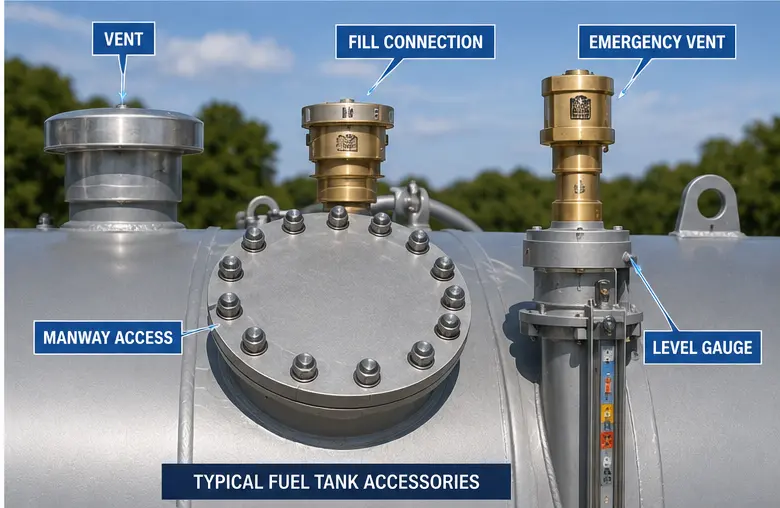
Fill Connections
Fuel fill connections provide the primary interface between delivery vehicles and storage tanks. They are designed to facilitate efficient fuel transfer while minimizing the risk of spills or contamination.
Fill assemblies are typically selected based on transfer rates, fuel type, connection compatibility, and expected delivery frequency. Proper placement also improves accessibility for maintenance personnel and fuel delivery operators.
Vent Systems
As fuel enters or leaves a tank, air must move freely to prevent excessive internal pressure or vacuum conditions. Vent piping maintains pressure equilibrium while reducing stress on the tank shell.
Vent systems must be sized according to applicable fire and engineering standards to ensure adequate airflow during normal operation.
Emergency Vents
Emergency vents supplement normal venting by providing pressure relief during abnormal operating conditions such as external fire exposure.
These devices help protect tank integrity by limiting excessive internal pressure that could otherwise compromise the structure.
Fuel Level Gauges
Reliable fuel monitoring is essential for emergency power systems, industrial operations, and fleet fueling facilities.
Modern fuel tanks may incorporate:
- Mechanical gauges
- Float-operated indicators
- Ultrasonic level sensors
- Radar level transmitters
- Continuous digital monitoring systems
Automated monitoring improves inventory management while reducing the likelihood of unexpected fuel shortages.
Leak Detection Systems
Early leak detection protects both facility assets and the surrounding environment.
Depending on the tank configuration, monitoring may include:
- Interstitial monitoring for double-wall tanks
- Electronic leak detection sensors
- Pressure monitoring
- Remote alarm systems
Continuous monitoring enables maintenance personnel to respond quickly before small issues become significant environmental incidents.
Overfill Prevention
Overfilling remains one of the most common causes of fuel spills. Overfill prevention devices automatically stop or restrict incoming fuel when the tank reaches a predetermined level.
These systems help:
- Protect personnel
- Reduce cleanup costs
- Prevent environmental releases
- Improve compliance with facility operating procedures
Spill Containment
Secondary containment complements the primary tank by capturing accidental releases that may occur during filling, maintenance, or equipment failure.
Containment systems may include:
- Double-wall construction
- Integral containment basins
- Concrete containment structures
- Spill collection sumps
The appropriate containment strategy depends on project-specific regulatory requirements and environmental risk assessments.
Monitoring and Automation
Modern industrial facilities increasingly integrate fuel systems into building automation platforms. Remote monitoring enables operators to track fuel inventory, receive alarm notifications, schedule preventive maintenance, and identify abnormal operating conditions without routine manual inspections.
When combined with quality fabrication, engineered support structures, and properly selected accessories, these monitoring systems significantly improve operational reliability while reducing lifecycle maintenance costs.
Conclusion
Fuel tanks are essential components of commercial, industrial, and mission-critical infrastructure, serving applications ranging from emergency generators and manufacturing plants to data centers, hospitals, transportation facilities, and heavy equipment. Their performance depends on much more than storage capacity. Successful fuel systems require careful integration of structural engineering, material selection, precision fabrication, corrosion protection, code compliance, and long-term maintenance planning.
Throughout the design process, engineers must evaluate operating loads, fuel compatibility, environmental exposure, fire protection requirements, thermal movement, and installation constraints. Decisions regarding tank configuration, support structures, anchorage, coatings, and accessories all influence lifecycle cost, operational reliability, and regulatory compliance. Adhering to recognized standards such as UL 142, UL 2085, NFPA 30, NFPA 37, the International Fire Code, EPA SPCC requirements, and applicable building codes helps ensure that fuel storage systems meet both safety and performance expectations.
Equally important is selecting a fabrication partner with the technical expertise to translate engineering requirements into reliable manufactured products. Precision laser cutting, CNC machining, qualified welding procedures, hydrostatic testing, and comprehensive quality assurance contribute to fuel tanks capable of performing under demanding service conditions for many years. For facilities located in seismic regions or supporting critical operations, integrating structural calculations, seismic anchorage design, and BIM coordination further enhances system resilience.
The Sigma Source supports engineers, contractors, OEM manufacturers, and facility owners with custom fuel tank fabrication, structural steel manufacturing, precision welding, laser and plasma cutting, BIM modeling, structural engineering, and seismic anchorage solutions. By combining engineering expertise with advanced manufacturing capabilities, the company delivers custom fuel storage systems and supporting structures tailored to the specific requirements of commercial, industrial, infrastructure, and healthcare projects. Whether developing a prototype, fabricating an OEM production run, or supporting a complex facility upgrade, a comprehensive engineering approach helps ensure every fuel tank system performs safely, efficiently, and reliably throughout its intended service life.
Frequently Asked Questions
What is the difference between a single-wall and double-wall fuel tank?
A single-wall fuel tank consists of one primary storage shell and is commonly used where external secondary containment is provided. A double-wall fuel tank incorporates an outer containment wall surrounding the primary tank, creating an interstitial space that can be monitored for leaks. Double-wall tanks provide additional environmental protection and are frequently selected for commercial, industrial, and generator applications where spill prevention is a priority.
What is a UL 142 fuel tank?
A UL 142 fuel tank is a factory-built aboveground steel tank evaluated to UL 142 standards for the storage of flammable and combustible liquids. The standard covers structural construction, welding, material requirements, testing, and manufacturing consistency. UL 142 tanks are widely specified for emergency generators, industrial fuel storage, fleet fueling, and commercial facilities.
When is a UL 2085 protected fuel tank required?
UL 2085 tanks are typically specified when enhanced fire resistance and impact protection are needed. Local fire codes, project specifications, insurance requirements, or owner preferences may require protected tanks for installations near occupied buildings or within critical infrastructure where additional fire protection is desirable.
What materials are commonly used to fabricate industrial fuel tanks?
Carbon steel remains the most common material because it provides excellent strength, weldability, and cost efficiency. Stainless steel is preferred for highly corrosive environments or specialty applications, while aluminum offers lightweight construction for mobile equipment and transportation uses. Material selection depends on fuel type, operating environment, maintenance expectations, and lifecycle cost.
How are fuel tanks designed to prevent corrosion?
Corrosion protection begins with proper material selection and continues through surface preparation and protective coatings. Engineers may specify epoxy coatings, polyurethane finishes, galvanizing, or corrosion-resistant stainless steels depending on environmental exposure. Proper drainage, maintenance access, and routine inspections also help extend service life.
What is secondary containment and when is it required?
Secondary containment is a backup system designed to capture fuel if the primary tank leaks or fails. It may consist of double-wall construction, containment basins, or engineered concrete structures. Requirements vary based on environmental regulations, fuel volume, facility location, and applicable codes, including EPA SPCC requirements.
What codes apply to aboveground fuel tanks?
Commonly referenced standards include UL 142, UL 2085, NFPA 30, NFPA 37, the International Fire Code, OSHA workplace safety regulations, EPA SPCC requirements, and applicable local building and fire codes. In seismic regions, IBC, CBC, and ASCE 7 may also influence anchorage and structural support design.
How are fuel tanks anchored for seismic loads?
Seismic anchorage is engineered by evaluating tank weight, operating fuel level, seismic design category, foundation capacity, and anticipated lateral forces. Structural engineers design anchor bolts, hold-down systems, and support frames to resist sliding and overturning while protecting connected piping during earthquake events.
What welding standards apply to fuel tank fabrication?
Structural components are commonly fabricated in accordance with AWS D1.1 for steel construction, while stainless steel fabrication may reference AWS D1.6. Qualified welding procedures, certified welders, visual inspection, and pressure or hydrostatic testing help verify weld quality before the tank enters service.
Can custom fuel tanks be manufactured for generators and heavy equipment?
Yes. Custom fuel tanks are routinely fabricated for standby generators, construction equipment, mining machinery, agricultural equipment, industrial machinery, marine applications, and OEM products. Customization may include unique dimensions, integrated skids, mounting brackets, piping connections, instrumentation, and specialized coatings.
How does BIM improve fuel tank installation and coordination?
Building Information Modeling (BIM) allows engineers to coordinate fuel tanks with structural steel, mechanical systems, electrical infrastructure, and architectural elements before construction begins. Clash detection reduces field conflicts, improves installation sequencing, and minimizes costly rework on complex commercial and industrial projects.
What should engineers consider when selecting a fuel tank manufacturer?
Engineers should evaluate fabrication capabilities, engineering support, welding qualifications, quality assurance procedures, material sourcing, testing methods, experience with applicable standards, prototype development capabilities, production capacity, and the ability to provide fabrication drawings, BIM models, and long-term technical support. A manufacturer with integrated engineering and fabrication expertise can help ensure that the finished fuel tank meets project requirements while simplifying coordination throughout design, manufacturing, installation, and future maintenance.