
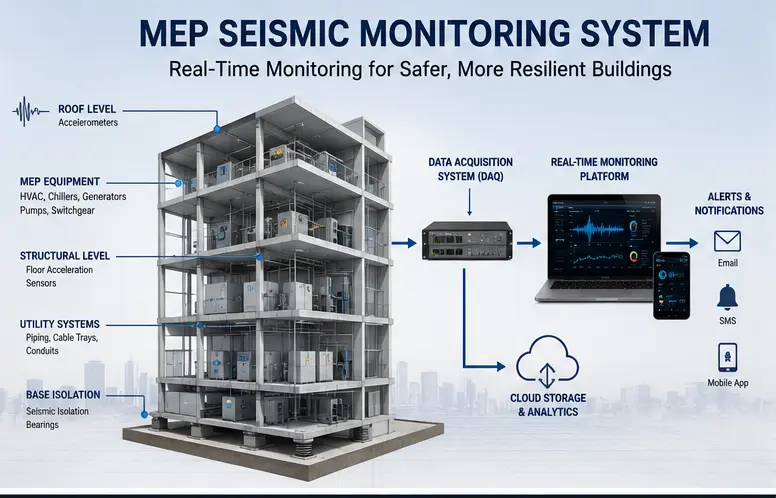
Modern buildings rely on complex mechanical, electrical, and plumbing (MEP) systems to maintain safe, continuous operations. HVAC equipment regulates indoor environments, electrical infrastructure distributes power to critical loads, fire protection systems safeguard occupants, and plumbing networks support sanitation and process operations. During an earthquake, however, these nonstructural systems are often more vulnerable than the structural frame itself. Even when a building remains structurally sound, excessive movement of MEP equipment can interrupt operations, damage expensive assets, and significantly extend recovery time.
MEP seismic monitoring has emerged as an important engineering strategy for understanding how buildings and critical equipment respond before, during, and after seismic events. Rather than replacing seismic bracing or anchorage systems, monitoring provides measurable data that helps engineers evaluate structural performance, equipment behavior, and operational readiness. By combining seismic sensors, data acquisition systems, cloud-based analytics, and structural engineering expertise, facility owners gain valuable insight into how their infrastructure performs under real-world conditions.
This capability is especially valuable in hospitals, data centers, pharmaceutical manufacturing facilities, semiconductor plants, airports, emergency operations centers, and other mission-critical environments where equipment downtime can have significant operational or financial consequences. Monitoring systems also support post-earthquake inspections by identifying areas that may require engineering evaluation before facilities resume full operation.
As building technologies continue to evolve, seismic monitoring is increasingly integrated with Building Management Systems (BMS), Building Automation Systems (BAS), digital twins, and BIM-based facility management. These technologies create a more comprehensive understanding of facility performance throughout its lifecycle.
This guide explains how MEP seismic monitoring systems work, the technologies involved, applicable U.S. engineering standards, and how structural engineering, seismic calculations, BIM coordination, and custom support fabrication contribute to resilient, code-compliant facilities.
What Is MEP Seismic Monitoring?
MEP seismic monitoring is the process of continuously measuring and recording the behavior of mechanical, electrical, and plumbing systems before, during, and after seismic events. Unlike seismic restraint systems, which physically limit movement using braces, anchors, and support assemblies, monitoring systems collect engineering data that allows designers and facility managers to understand how equipment responds to earthquake loading.
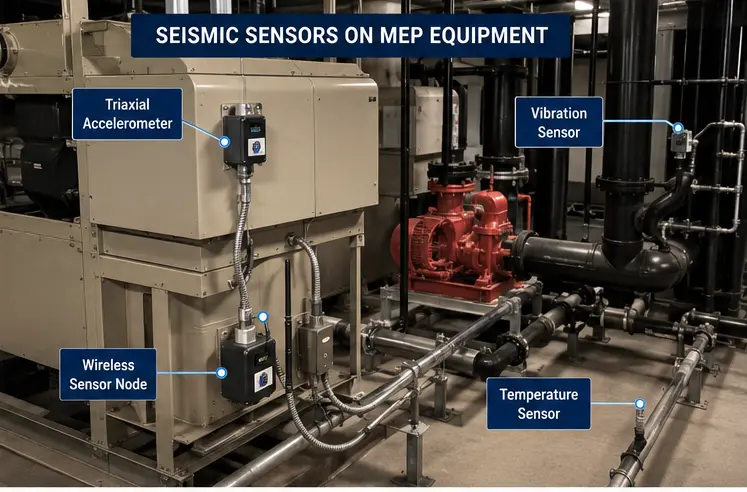
A typical monitoring system consists of triaxial accelerometers, vibration sensors, displacement sensors, data acquisition hardware, communication gateways, and monitoring software. These components measure variables such as acceleration, equipment displacement, structural drift, vibration frequency, and peak ground acceleration (PGA). The resulting data provides engineers with an objective record of building performance instead of relying solely on visual inspections.
It is important to distinguish seismic monitoring from conventional vibration monitoring. Vibration monitoring generally evaluates rotating equipment during normal operation to identify maintenance issues such as bearing wear or imbalance. Seismic monitoring focuses specifically on earthquake-induced movement and the structural response of buildings and equipment subjected to dynamic seismic forces.
For modern commercial buildings, monitoring extends beyond the structural frame. HVAC units, cooling towers, electrical switchgear, emergency generators, fuel systems, cable tray networks, fire sprinkler piping, and suspended mechanical equipment can all benefit from strategically located monitoring devices. These systems are frequently interconnected, meaning movement in one component may influence adjacent systems.
When integrated with resilient design practices, monitoring provides valuable information for engineers conducting post-earthquake assessments. Instead of assuming that all equipment experienced identical loading, engineers can evaluate recorded performance and prioritize inspections where the highest movements occurred.
For organizations responsible for critical infrastructure, MEP seismic monitoring serves as an engineering decision-support tool that complements seismic bracing, equipment anchorage, vibration isolation, and structural health monitoring programs rather than replacing them.
MEP Seismic Monitoring Guide
Why Seismic Monitoring Is Critical for MEP Systems
Although building structures are typically designed to satisfy life-safety requirements under the International Building Code (IBC), California Building Code (CBC), and ASCE 7, maintaining operational continuity requires additional consideration for nonstructural systems. Mechanical and electrical equipment often represents a significant investment, and damage to these systems can disrupt facility operations long after an earthquake has ended.
Hospitals illustrate this challenge particularly well. Diagnostic imaging equipment, emergency generators, medical gas piping, electrical distribution systems, and HVAC equipment must remain functional to support patient care. Similar operational requirements exist for data centers, pharmaceutical manufacturing plants, airports, emergency communication facilities, and water treatment plants.
Seismic monitoring provides engineers with quantitative information regarding equipment movement during seismic events. Rather than depending entirely on post-event visual inspections, facility teams can evaluate acceleration histories, displacement records, and equipment responses to determine whether additional engineering evaluation is necessary.
Monitoring also improves emergency response planning. Automated alarm systems can immediately notify facility operators when predefined thresholds are exceeded, allowing engineering teams to initiate inspections or operational protocols more efficiently.
Another important benefit is long-term resilience planning. Continuous monitoring enables facility managers to establish baseline equipment performance and identify gradual changes that may indicate loosening anchors, deteriorating supports, or excessive operational vibration. While these issues may not be earthquake-related, identifying them early improves overall system reliability.
For facilities with redundant equipment, monitoring data supports informed decision-making during emergency operations. Engineers can compare the performance of multiple systems, evaluate equipment functionality, and determine which assets remain suitable for continued operation following seismic activity.
Ultimately, seismic monitoring transforms facility resilience from reactive inspections into data-driven engineering, helping organizations minimize downtime, improve life-cycle asset management, and strengthen business continuity planning.
Components of an MEP Seismic Monitoring System
An effective MEP seismic monitoring system combines sensors, communications hardware, software platforms, and engineering analysis into a coordinated solution that continuously evaluates how building systems respond to seismic activity. Rather than relying on a single sensor or isolated measurement, modern monitoring systems collect synchronized data from multiple locations throughout a facility to provide engineers with a comprehensive understanding of structural and nonstructural performance.
Triaxial Accelerometers
Triaxial accelerometers are the primary sensing devices used in seismic monitoring. Unlike single-axis sensors, they measure acceleration simultaneously in three orthogonal directions, allowing engineers to evaluate horizontal and vertical movement during an earthquake. These sensors may be installed on structural floors, equipment bases, mechanical platforms, pipe racks, or critical electrical systems to capture localized responses.
Because different pieces of equipment experience different levels of acceleration depending on their elevation and support conditions, multiple accelerometers are typically distributed throughout the building. Their measurements help engineers compare equipment behavior with design assumptions established during seismic calculations.
Vibration Sensors
While accelerometers capture transient earthquake motion, vibration sensors also provide valuable information about equipment operating under normal conditions. Chillers, pumps, air handling units, cooling towers, and rotating machinery naturally generate vibration during operation. Establishing a baseline operating profile allows engineers to distinguish between routine equipment vibration and abnormal movement caused by seismic events.
This distinction is particularly useful after an earthquake, when facilities need to determine whether elevated vibration levels indicate structural damage, loose anchorage, or mechanical equipment requiring maintenance before returning to service.
Data Acquisition Systems
A monitoring system is only as effective as its ability to capture and process information. Data acquisition systems (DAQ) collect signals from numerous sensors simultaneously, synchronize the measurements, and convert analog signals into digital engineering data.
Modern DAQ hardware supports high-speed sampling, redundant storage, synchronized timestamps, and integration with facility networks. During a seismic event, these systems continuously record acceleration histories, vibration amplitudes, and sensor status without requiring manual intervention.
For mission-critical facilities, redundant power supplies and battery backup systems ensure that monitoring continues even if utility power is interrupted.
Wireless Monitoring Devices
Wireless sensor networks have become increasingly common in retrofit projects where installing extensive communication wiring would be expensive or disruptive. Wireless monitoring devices communicate through secure industrial protocols, allowing sensors to transmit data to centralized gateways without significant modifications to existing infrastructure.
These systems simplify installation while supporting scalable monitoring programs that can expand as facilities evolve. Engineers can add sensors to new mechanical rooms, equipment upgrades, or building additions without redesigning the entire monitoring network.
Wireless technology also enables temporary monitoring during commissioning, equipment replacement projects, or post-earthquake investigations.
Monitoring Software
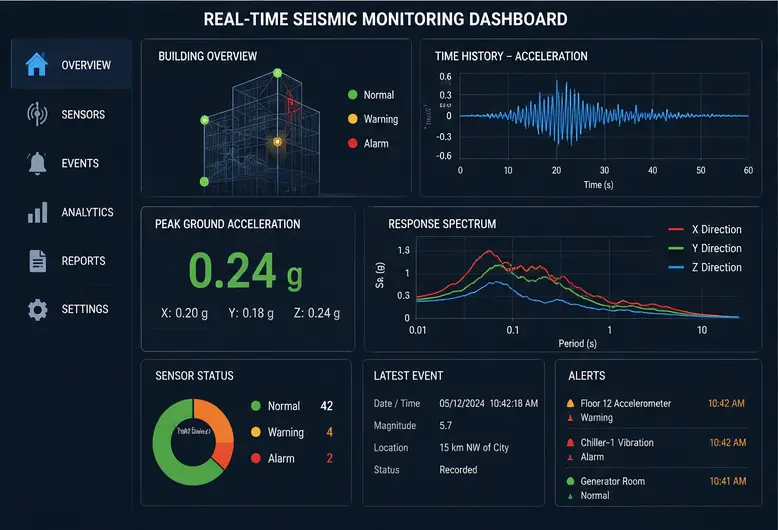
Raw sensor data has limited value without effective visualization and analysis. Modern monitoring platforms organize large volumes of information into intuitive dashboards that display equipment status, acceleration trends, historical events, and alarm conditions.
Engineering software often includes configurable thresholds, automated reporting, event playback, trend analysis, and graphical comparisons between multiple sensor locations. Cloud-based platforms further enable engineers to access facility information remotely while maintaining secure data storage and backup capabilities.
Historical datasets also become valuable engineering references when evaluating future seismic events or validating structural upgrades.
Alarm and Notification Systems
An important function of seismic monitoring is timely notification. Monitoring platforms can automatically generate alarms when measured values exceed predetermined engineering thresholds. Alerts may be delivered through email, text messages, control room displays, or Building Management Systems (BMS), allowing facility operators to begin inspections or emergency procedures immediately.
Instead of replacing engineering judgment, alarm systems prioritize attention where it is most needed, enabling maintenance personnel and structural engineers to respond more efficiently after seismic activity. When integrated with broader emergency response plans, automated notifications help reduce inspection time and support faster restoration of essential building services.
Structural Health Monitoring (SHM) for MEP Infrastructure
Structural Health Monitoring (SHM) extends seismic monitoring beyond individual pieces of equipment by evaluating the behavior of both the building structure and the nonstructural systems it supports. For engineers responsible for resilient facility design, SHM provides objective performance data that can improve design validation, maintenance planning, and post-earthquake decision-making.
MEP Seismic Monitoring
Building Response Monitoring
During an earthquake, every floor of a building responds differently depending on structural stiffness, height, and dynamic characteristics. Monitoring systems installed throughout the structure record acceleration and displacement at multiple elevations, allowing engineers to understand how seismic forces propagate through the building.
These measurements can be compared with analytical models developed during structural design to confirm whether the building is performing within expected parameters.
Equipment Response Monitoring
Even when the building remains within acceptable performance limits, individual MEP systems may experience significantly different movements. Large air handling units, rooftop equipment, emergency generators, electrical switchgear, and suspended piping often have unique support conditions that influence their seismic response.
By placing sensors directly on equipment supports or anchorage systems, engineers can determine whether excessive movement occurred during an event and identify equipment requiring closer inspection before being returned to service.
Floor Acceleration
Floor acceleration is one of the most important parameters for nonstructural seismic design. Equipment installed on upper stories frequently experiences greater acceleration than equipment located near the foundation due to amplification effects.
Monitoring actual floor acceleration helps engineers evaluate the adequacy of seismic restraints, vibration isolation systems, and equipment anchorage. The data may also support future renovations or equipment replacements by providing realistic design inputs rather than relying solely on generalized analytical assumptions.
Structural Drift
Building drift refers to the relative horizontal displacement between adjacent floors during seismic loading. Excessive drift can place additional demands on piping systems, electrical conduits, cable trays, expansion joints, and flexible utility connections.
Monitoring drift helps engineers determine whether nonstructural systems remained within acceptable movement limits or whether further evaluation is warranted. Facilities containing sensitive medical equipment or precision manufacturing systems often benefit from this additional level of performance assessment.
Equipment Displacement
Displacement sensors complement accelerometers by directly measuring equipment movement relative to supporting structures. These measurements are particularly valuable for large suspended systems, isolated equipment, or machinery installed on vibration isolation platforms.
By comparing recorded displacement with allowable movement established during design, engineers gain confidence that equipment anchorage, support frames, and seismic restraints have functioned as intended.
Performance Verification
One of the greatest benefits of SHM is its ability to verify engineering assumptions using real-world data. Rather than relying exclusively on analytical models, facility owners obtain measurable evidence regarding how structures and equipment perform during actual seismic events.
This information supports continuous improvement of future projects, informs maintenance planning, and strengthens resilience programs for organizations responsible for hospitals, data centers, manufacturing facilities, government buildings, and other critical infrastructure. By integrating monitoring data with structural engineering expertise, BIM coordination, and seismic design services, organizations can make more informed decisions that improve both safety and long-term operational reliability.
Monitoring Mechanical, Electrical, and Plumbing Systems
An effective MEP seismic monitoring program must evaluate the performance of individual building systems as well as their interaction during seismic events. Mechanical, electrical, and plumbing systems are interconnected, and failure in one system can significantly affect the operation of others. Monitoring these systems provides engineers with valuable data for post-earthquake inspections, preventive maintenance, and long-term facility resilience planning.
HVAC Equipment
HVAC systems often include air handling units, rooftop units, chillers, cooling towers, fan arrays, and ductwork supported by structural steel frames or suspended hangers. These components can experience substantial inertial forces during an earthquake, particularly in multi-story buildings where floor accelerations are amplified.
Installing seismic monitoring sensors on equipment bases, support frames, and adjacent structural elements allows engineers to compare actual equipment movement with expected design performance. Monitoring data can also verify whether seismic restraints, vibration isolation systems, and flexible duct connections functioned as intended during an event.
Chillers and Cooling Towers
Large chillers and cooling towers represent significant capital investments and are often critical to hospital, pharmaceutical, semiconductor, and data center operations. Because these systems typically operate on vibration isolation mounts while also requiring seismic restraint, engineers must balance operational vibration control with earthquake protection.
Monitoring acceleration, displacement, and vibration levels helps confirm that isolation systems continue performing correctly after seismic events and assists maintenance teams in identifying equipment that requires detailed inspection before being returned to service.
Pumps
Fire pumps, chilled water pumps, domestic water booster pumps, and process pumps are essential to many commercial and industrial facilities. Pump monitoring can identify abnormal shaft vibration, support movement, or foundation displacement following an earthquake. Combined with pressure and flow monitoring, seismic data provides a more complete picture of equipment condition and operational readiness.
Electrical Switchgear
Electrical distribution equipment is particularly sensitive because even minor misalignment or internal damage may interrupt power to critical building systems. Monitoring switchgear rooms using triaxial accelerometers allows engineers to evaluate whether equipment experienced movements beyond design expectations, supporting safer post-earthquake energization procedures.
Emergency Generators
Backup generators must remain operational immediately after seismic events, particularly in hospitals, emergency operations centers, airports, and mission-critical industrial facilities. Monitoring systems can verify generator support frame behavior, fuel system movement, vibration isolation performance, and anchorage integrity, helping ensure emergency power remains available when needed most.
Cable Tray Systems
Extensive cable tray networks distribute power, communication, and control wiring throughout modern buildings. Monitoring key sections of these systems can identify excessive movement that may affect electrical continuity or damage cable supports. This information supports inspections of high-priority circuits before facilities resume full operation.
Pipe Support Systems
Mechanical piping, fire sprinkler systems, medical gas piping, and process piping often include seismic bracing, flexible connections, and expansion joints. Sensors installed near pipe supports or major equipment connections help engineers evaluate piping movement and identify areas that may require detailed inspection following seismic activity. When combined with visual assessments, monitoring data improves confidence that critical utility systems remain functional and code-compliant.
Real-Time Seismic Monitoring and Data Analytics
Modern seismic monitoring extends beyond recording earthquake events. Advances in sensor technology, cloud computing, and engineering analytics allow facilities to evaluate equipment performance continuously, transforming raw measurements into actionable engineering information.
Continuous Monitoring
Continuous monitoring establishes a baseline understanding of how equipment behaves during normal operations. This baseline allows engineers to distinguish between operational vibration, maintenance-related issues, and movement caused by seismic events. Continuous monitoring also provides historical trends that support long-term asset management and equipment lifecycle planning.
Rather than collecting data only during emergencies, facilities gain ongoing visibility into equipment health, improving predictive maintenance strategies and reducing unexpected failures.
Peak Ground Acceleration (PGA)
Peak Ground Acceleration is one of the most widely used engineering parameters for evaluating earthquake intensity at a specific location. By comparing measured PGA values with design assumptions used during structural calculations, engineers can better understand how actual seismic conditions compare with anticipated design loads.
PGA measurements also assist in determining whether equipment inspections should be prioritized following moderate or significant seismic events.
Response Spectrum Analysis
Response spectrum analysis is commonly used during structural design to estimate how buildings and equipment respond to different vibration frequencies. Monitoring systems provide real-world acceleration data that engineers can compare with analytical response spectra, improving confidence in design assumptions and identifying opportunities for future system optimization.
This comparison is particularly valuable for specialized facilities containing sensitive medical, laboratory, or manufacturing equipment.
Time-History Recording
Unlike summary statistics, time-history recordings capture the complete sequence of structural and equipment movement throughout an earthquake. Engineers can analyze acceleration, velocity, and displacement over time to evaluate equipment response, identify peak loading conditions, and investigate unexpected behavior.
Time-history data is especially useful when conducting forensic engineering studies or validating advanced structural analysis models.
Cloud-Based Dashboards
Cloud-based monitoring platforms allow facility managers, consulting engineers, and maintenance personnel to access seismic information from virtually any location. Interactive dashboards display sensor status, historical events, alarm conditions, equipment trends, and performance summaries through secure web interfaces.
These platforms simplify reporting while allowing multiple stakeholders to review the same engineering data during emergency response or routine maintenance planning.
Predictive Maintenance
Although seismic monitoring focuses on earthquake performance, the same sensor network often supports predictive maintenance initiatives. Changes in vibration characteristics, equipment alignment, or structural response may indicate developing maintenance issues before failures occur. Integrating these insights into facility maintenance programs reduces repair costs, extends equipment service life, and improves operational reliability.
Remote Diagnostics
Remote diagnostics allow engineering teams to review seismic data immediately after an event without waiting for on-site inspections. For organizations managing multiple facilities, centralized monitoring improves situational awareness and enables resources to be directed toward locations experiencing the highest levels of seismic activity.
By combining real-time monitoring, advanced analytics, and engineering expertise, organizations gain a more complete understanding of facility performance while improving resilience, inspection efficiency, and operational continuity.
Codes, Standards, and Regulatory Considerations
MEP seismic monitoring systems should be developed within the broader framework of U.S. structural engineering, life-safety, and facility resilience standards. Although building codes generally prescribe requirements for seismic design and restraint rather than monitoring itself, monitoring systems provide valuable information that supports compliance verification, post-earthquake evaluation, and long-term facility management.
ASCE 7
ASCE 7, Minimum Design Loads and Associated Criteria for Buildings and Other Structures, establishes the seismic design criteria used for buildings and nonstructural components throughout the United States. It defines seismic design forces, importance factors, component anchorage requirements, and performance expectations for mechanical and electrical equipment.
Monitoring systems do not replace ASCE 7 compliance but provide measurable performance data that complements structural analysis and equipment qualification.
International Building Code (IBC)
The International Building Code incorporates ASCE 7 by reference and establishes minimum requirements for protecting occupants and maintaining structural integrity during seismic events. Engineers designing monitoring systems should coordinate sensor placement with structural layouts, equipment supports, and seismic restraint details developed during code-compliant design.
California Building Code (CBC)
For projects located in California, the CBC introduces additional seismic considerations due to the state’s elevated seismic hazard. Healthcare, research, and mission-critical facilities frequently require more detailed engineering coordination to ensure nonstructural systems achieve the intended level of seismic performance.
Monitoring data can support facility owners in evaluating system behavior after earthquakes and planning engineering inspections where necessary.
HCAI Requirements
Healthcare facilities regulated by the California Department of Health Care Access and Information (HCAI), formerly OSHPD, require careful coordination of structural and nonstructural systems to maintain post-earthquake functionality. Monitoring systems can complement HCAI-compliant seismic bracing, equipment anchorage, and vibration isolation strategies by providing objective information regarding equipment performance after seismic events.
FEMA E-74 and FEMA P-58
FEMA E-74 offers practical guidance for reducing earthquake damage to nonstructural components, while FEMA P-58 provides methodologies for seismic performance assessment based on building functionality and repair consequences. Together, these resources support performance-based engineering approaches where monitoring data enhances post-event decision-making and resilience planning.
ASCE 41
ASCE 41 provides guidance for evaluating and retrofitting existing buildings. During renovation projects, monitoring systems can establish baseline performance before upgrades and assist engineers in validating improvements after retrofit work has been completed.
NFPA 70
When monitoring systems require dedicated power supplies, communication wiring, or integration with electrical infrastructure, installation practices should comply with the National Electrical Code (NFPA 70). Proper routing, protection, and labeling of monitoring circuits contribute to long-term reliability and maintainability.
OSHA Considerations
Installation and maintenance activities must also comply with OSHA workplace safety requirements. Engineers should consider safe access to sensors, communication equipment, and monitoring hardware during both routine maintenance and post-earthquake inspections.
By integrating seismic monitoring with established engineering standards, structural analysis, BIM coordination, and quality construction practices, organizations create a more resilient facility while supporting informed engineering decisions throughout the building’s operational life.
Integrating Seismic Monitoring with BIM and Building Automation
Modern facilities generate large amounts of operational data, and seismic monitoring is most effective when it is integrated into the building’s broader digital infrastructure rather than operating as an isolated system. By combining seismic monitoring with Building Information Modeling (BIM), Building Management Systems (BMS), Building Automation Systems (BAS), and Industrial Internet of Things (IIoT) technologies, facility owners gain a comprehensive view of both structural and nonstructural performance.
BIM Coordination
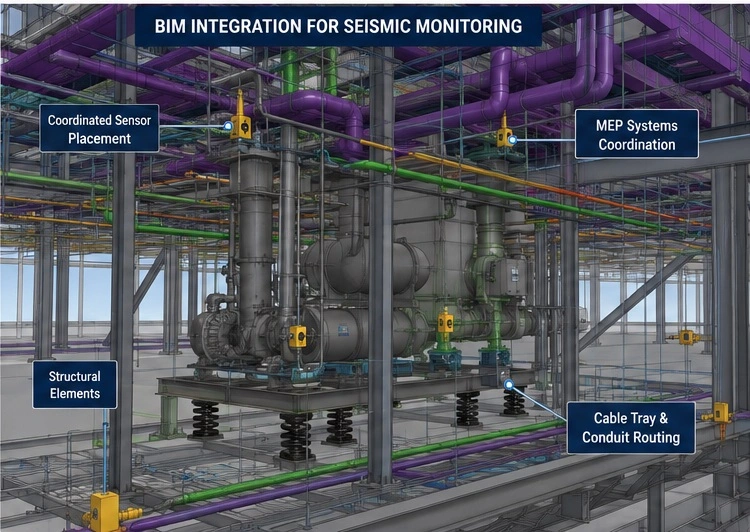
Building Information Modeling provides a centralized digital representation of building components throughout design, construction, and facility operations. Incorporating seismic monitoring during BIM coordination allows engineers to determine optimal sensor locations while avoiding conflicts with HVAC ductwork, piping, cable trays, structural framing, and architectural systems.
BIM models also simplify future maintenance because each monitoring device can be associated with equipment schedules, manufacturer documentation, calibration records, and maintenance histories. Engineers and facility managers can quickly identify sensor locations within complex mechanical rooms or utility spaces without relying solely on as-built drawings.
Digital Twins
Digital twin technology expands upon BIM by creating a continuously updated digital model that reflects the actual operating condition of a facility. Seismic monitoring data can feed directly into digital twins, enabling engineers to compare measured equipment movement with analytical models developed during structural design.
Over time, digital twins improve engineering decision-making by identifying recurring trends, evaluating equipment performance, and supporting predictive maintenance strategies based on real operational data instead of assumptions.
Building Management Systems (BMS)
Many commercial buildings already use Building Management Systems to monitor HVAC operation, energy consumption, fire alarms, and security systems. Integrating seismic monitoring into the BMS enables facility operators to receive earthquake-related alerts within the same interface used for daily building operations.
Following a seismic event, operators can immediately review sensor status, alarm conditions, equipment shutdown sequences, and affected building zones without switching between multiple software platforms.
Building Automation Systems (BAS)
Building Automation Systems provide another opportunity for integration. Depending on facility requirements and engineering design, BAS platforms may initiate predefined responses when seismic thresholds are exceeded. These responses can include shutting down sensitive mechanical equipment, isolating fuel systems, securing elevators, or notifying emergency response personnel.
Any automated response should be carefully engineered to align with facility-specific operational requirements, applicable codes, and owner objectives.
IoT Sensor Integration
Industrial IoT technologies continue to improve the scalability of seismic monitoring systems. Wireless sensors, edge computing devices, and secure cloud communication allow monitoring networks to expand without extensive rewiring or infrastructure modifications.
This flexibility is particularly beneficial for campuses, hospitals, manufacturing facilities, and existing buildings undergoing phased renovations. Additional sensors can be incorporated as facilities grow, ensuring monitoring capabilities evolve alongside operational needs.
Asset Management
Seismic monitoring also contributes to long-term asset management. Historical monitoring records help facility owners prioritize equipment replacement, evaluate lifecycle costs, and plan capital improvements based on measured performance rather than estimated service life. When combined with computerized maintenance management systems (CMMS), monitoring data supports more informed maintenance planning and investment decisions.
Monitoring Critical Facilities
Not every building requires the same level of seismic monitoring. Facilities supporting essential services, life safety, or continuous operations often justify more comprehensive monitoring because equipment downtime carries significant operational, financial, or public safety consequences.
Hospitals
Hospitals depend on uninterrupted operation of HVAC systems, emergency generators, medical gas piping, electrical distribution equipment, and specialized diagnostic devices. Even if a building remains structurally sound after an earthquake, damage to these nonstructural systems can affect patient care.
Seismic monitoring helps engineering teams prioritize inspections, verify equipment performance, and support informed decisions regarding continued operation. Combined with HCAI-compliant seismic restraints and anchorage systems, monitoring contributes to healthcare facility resilience.
Data Centers
Data centers require continuous operation of servers, cooling systems, electrical switchgear, backup generators, and fuel infrastructure. Monitoring allows facility operators to evaluate whether critical support equipment experienced excessive movement during seismic events while minimizing unnecessary service interruptions.
Emergency Operations Centers
Police departments, emergency communication centers, fire stations, and disaster response facilities must remain operational immediately following earthquakes. Monitoring systems provide engineering data that supports rapid facility assessments and operational continuity when emergency services are most needed.
Airports
Airports contain extensive mechanical infrastructure, electrical distribution systems, baggage handling equipment, and communication networks. Monitoring assists facility engineers in evaluating equipment performance while supporting efficient inspection procedures that reduce operational disruptions.
Pharmaceutical Facilities
Pharmaceutical manufacturing requires strict environmental control and equipment reliability. Monitoring sensitive HVAC systems, cleanroom equipment, and process utilities helps maintain product quality while supporting regulatory compliance following seismic events.
Semiconductor Plants
Semiconductor manufacturing equipment often has extremely low tolerance for movement. High-resolution monitoring enables engineers to evaluate vibration-sensitive production tools and determine whether recalibration or inspection is necessary before manufacturing resumes.
Utility Infrastructure
Water treatment plants, wastewater facilities, electrical substations, and utility control centers support essential community services. Monitoring systems provide valuable engineering information that assists utility operators in prioritizing inspections and restoring critical infrastructure following earthquakes.
Government Buildings
Government facilities frequently serve as emergency coordination centers during disasters. Integrating seismic monitoring into these facilities supports resilience planning, improves post-event decision-making, and enhances long-term infrastructure management.
Real Time Seismic Monitoring Systems
Engineering Design Considerations
Successful seismic monitoring begins during project planning rather than after construction is complete. Engineers should develop monitoring strategies that complement structural design, seismic restraint systems, equipment anchorage, and facility operations.
Sensor Placement
Proper sensor placement is essential for collecting meaningful engineering data. Sensors should be installed where they can accurately capture structural response, equipment acceleration, displacement, and floor motion without interfering with normal operations or maintenance access.
Equipment Anchorage
Monitoring systems should be coordinated with equipment anchorage details developed during structural engineering. Comparing measured equipment movement with expected anchorage performance provides valuable feedback regarding restraint effectiveness and future design improvements.
Monitoring Redundancy
Mission-critical facilities often benefit from redundant sensors, communication pathways, and power supplies. Redundancy increases confidence that monitoring data remains available even if individual components experience failures during major seismic events.
Communication Networks
Reliable communication infrastructure ensures sensor information reaches data acquisition systems and monitoring platforms without interruption. Engineers should evaluate wired and wireless communication options based on facility size, cybersecurity requirements, and operational priorities.
Cybersecurity
As monitoring systems become increasingly connected to enterprise networks and cloud platforms, cybersecurity becomes an important engineering consideration. Secure communication protocols, access controls, encryption, and regular software updates help protect monitoring infrastructure from unauthorized access.
Power Redundancy
Monitoring equipment should remain operational during power interruptions. Backup batteries, uninterruptible power supplies (UPS), or emergency generator connections enable continued data collection during and immediately after seismic events.
Environmental Protection
Sensors and monitoring hardware should be selected according to environmental conditions such as temperature extremes, humidity, dust, vibration, and corrosive atmospheres. Proper environmental protection improves long-term reliability while reducing maintenance requirements.
How Engineering Services Improve Seismic Monitoring Performance
Technology alone does not ensure an effective monitoring program. Successful implementation depends on structural engineering expertise, multidisciplinary coordination, and accurate documentation throughout the project lifecycle.
Structural engineers determine monitoring objectives, identify critical equipment, evaluate structural response, and coordinate sensor placement with seismic restraint systems. Seismic calculations establish expected loading conditions while helping engineers interpret monitoring data after an earthquake.
BIM 3D modeling improves interdisciplinary coordination by integrating monitoring devices with structural framing, HVAC systems, electrical distribution, piping layouts, and architectural components before construction begins. This reduces installation conflicts and simplifies future maintenance.
Detailed CAD fabrication drawings also improve the installation of custom equipment supports, sensor brackets, cable management systems, and structural mounting assemblies. When required, custom metal fabrication—including laser cutting, CNC machining, precision welding, and powder coating—can produce durable support hardware tailored to project-specific requirements.
Construction support and commissioning complete the implementation process. Engineering teams verify sensor installation, calibrate monitoring equipment, validate communication networks, and confirm proper integration with Building Management Systems before facilities become operational.
Organizations seeking long-term resilience often benefit from combining seismic monitoring with broader engineering services, including structural evaluations, seismic bracing design, vibration isolation, equipment anchorage, BIM coordination, and ongoing facility support. This integrated approach creates monitoring systems that provide reliable engineering information throughout the building’s service life.
Choosing the Right Engineering Partner for MEP Seismic Monitoring
Selecting an engineering partner involves more than purchasing monitoring equipment. Successful projects require organizations capable of integrating structural engineering, seismic design, MEP coordination, digital technologies, and custom fabrication into a cohesive solution.
Engineers should evaluate experience with ASCE 7, the International Building Code, the California Building Code, and HCAI requirements for healthcare facilities when applicable. Familiarity with mission-critical environments—including hospitals, data centers, laboratories, industrial facilities, and government infrastructure—is equally important.
A qualified engineering partner should also demonstrate expertise in seismic calculations, equipment anchorage, BIM coordination, sensor integration, data interpretation, and post-earthquake assessment methodologies. For projects requiring specialized mounting systems, in-house custom metal fabrication capabilities provide greater flexibility for designing sensor supports, equipment frames, and structural attachments.
The Sigma Source combines structural engineering, seismic engineering, vibration isolation, BIM coordination, custom metal fabrication, and construction support to help clients develop resilient MEP systems for commercial and industrial projects. By integrating engineering analysis with practical fabrication expertise, project teams receive coordinated solutions that support long-term reliability rather than isolated components.
Whether designing a new facility or upgrading existing infrastructure, selecting an experienced engineering partner helps ensure seismic monitoring systems provide accurate data, support informed engineering decisions, and contribute to safer, more resilient building operations.
Conclusion
MEP seismic monitoring has become an increasingly valuable component of resilient facility design because it provides engineers with measurable insight into how buildings and critical equipment respond during seismic events. Rather than replacing seismic bracing, vibration isolation, or equipment anchorage, monitoring complements these systems by validating performance and supporting informed engineering decisions throughout a facility’s lifecycle.
Modern monitoring technologies—including triaxial accelerometers, wireless sensor networks, cloud-based analytics, and BIM-integrated engineering workflows—allow organizations to move beyond reactive inspections toward continuous performance evaluation. This capability is especially beneficial for hospitals, data centers, industrial plants, airports, utilities, and other mission-critical facilities where operational continuity is essential.
Successful implementation requires more than installing sensors. Effective monitoring depends on careful engineering design, strategic sensor placement, reliable communication infrastructure, integration with building management systems, and coordination with structural and MEP disciplines. When combined with seismic calculations, structural engineering, BIM coordination, custom fabrication, and quality construction practices, monitoring systems become valuable tools for improving resilience, reducing downtime, and supporting long-term asset management.
As performance-based design and digital facility management continue to evolve, MEP seismic monitoring will play an increasingly important role in helping owners understand infrastructure performance, prioritize maintenance, and strengthen preparedness for future seismic events. For organizations investing in resilient buildings, monitoring represents not only a source of engineering data but also a practical strategy for protecting people, equipment, and critical operations.
Frequently Asked Questions
What is MEP seismic monitoring?
MEP seismic monitoring uses sensors, data acquisition systems, and engineering software to measure how mechanical, electrical, and plumbing systems respond before, during, and after earthquakes. It supports post-event assessment and long-term resilience planning.
How does seismic monitoring differ from seismic bracing?
Seismic bracing physically restrains equipment to resist earthquake forces, while seismic monitoring measures equipment and structural movement. The two systems are complementary and are often used together on critical projects.
What sensors are used in MEP seismic monitoring systems?
Common devices include triaxial accelerometers, vibration sensors, displacement sensors, wireless monitoring units, and data acquisition hardware that records acceleration, displacement, and equipment response.
Why is seismic monitoring important for hospitals and critical facilities?
Hospitals and other mission-critical facilities must maintain essential operations after earthquakes. Monitoring provides objective engineering data that helps prioritize inspections, verify equipment performance, and support operational continuity.
How does structural health monitoring improve building resilience?
Structural health monitoring evaluates building and equipment behavior over time, allowing engineers to verify design assumptions, detect abnormal responses, and improve maintenance and resilience planning.
Can seismic monitoring systems integrate with Building Management Systems?
Yes. Modern monitoring platforms often integrate with Building Management Systems (BMS) and Building Automation Systems (BAS), enabling centralized alarms, reporting, and operational coordination.
What codes govern MEP seismic monitoring in the United States?
While monitoring itself is not extensively prescribed by building codes, projects are typically designed within the framework of ASCE 7, IBC, CBC, HCAI requirements where applicable, FEMA E-74, FEMA P-58, ASCE 41, and NFPA 70.
How are seismic monitoring sensors installed on MEP equipment?
Sensor placement depends on engineering objectives and equipment type. Sensors are commonly mounted on structural supports, equipment bases, anchorage systems, floor slabs, or adjacent structural members to accurately capture movement.
What data is collected during an earthquake?
Monitoring systems can record peak ground acceleration, floor acceleration, vibration frequency, displacement, structural drift, time-history data, equipment response, and alarm events for engineering evaluation.
Can existing buildings be retrofitted with seismic monitoring systems?
Yes. Wireless monitoring technologies and modular sensor networks make it practical to retrofit many existing commercial, industrial, healthcare, and institutional facilities with minimal disruption.
How does BIM improve seismic monitoring design and coordination?
BIM helps engineers coordinate sensor placement, communication pathways, structural supports, and equipment layouts while reducing installation conflicts and improving long-term facility management.
What should engineers consider when selecting an MEP seismic monitoring solution?
Important considerations include engineering expertise, code compliance, sensor accuracy, data quality, integration with BMS and BIM platforms, cybersecurity, scalability, maintenance support, and the provider’s experience with critical facilities and seismic engineering projects.